Kennedy Athletic Recreation and Social (Military) Kennedy Space Center Fl Reviews
 | |
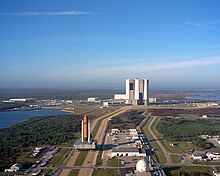
| Clockwise from the meridian: Vehicle Associates Building, Shuttle Landing Facility, Launch Control Center, Visitor Complex, KSC Headquarters Edifice and Launch Complex 39 | |
 KSC shown in white; CCSFS in green | |
| Abbreviation | KSC |
|---|---|
| Named after | John F. Kennedy |
| Formation | July 1, 1962 (1962-07-01) |
| Type | NASA facility |
| Location |
|
| Coordinates | 28°31′27″North 80°39′03″W / 28.52417°N 80.65083°W / 28.52417; -lxxx.65083 Coordinates: 28°31′27″Due north eighty°39′03″W / 28.52417°N eighty.65083°W / 28.52417; -lxxx.65083 |
| Official language | English language |
| Possessor | NASA |
| Director | Janet East. Petro[i] |
| Upkeep | US$two,218 million[2] (2021) |
| Staff | ten,733[ii] [note 1] (2021) |
| Website | www |
| Formerly called | Launch Operations Eye |
| [3] | |

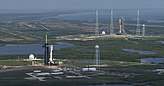

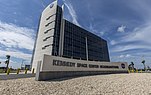
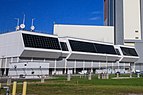

The John F. Kennedy Space Center (KSC, originally known equally the NASA Launch Operations Heart), located on Merritt Island, Florida, is one of the National Aeronautics and Space Administration's (NASA) ten field centers. Since Dec 1968, KSC has been NASA's principal launch center of human spaceflight. Launch operations for the Apollo, Skylab and Space Shuttle programs were carried out from Kennedy Space Center Launch Circuitous 39 and managed by KSC.[four] Located on the east coast of Florida, KSC is adjacent to Cape Canaveral Infinite Forcefulness Station (CCSFS). The management of the ii entities work very closely together, share resources and operate facilities on each other'south property.
Though the starting time Apollo flights and all Project Mercury and Projection Gemini flights took off from the then-Cape Canaveral Air Force Station, the launches were managed by KSC and its previous organization, the Launch Operations Directorate.[five] [6] Starting with the fourth Gemini mission, the NASA launch control center in Florida (Mercury Command Center, subsequently the Launch Command Center) began handing off control of the vehicle to the Mission Control Center in Houston, soon after liftoff; in prior missions it held control throughout the unabridged mission.[7] [8]
Additionally, the heart manages launch of robotic and commercial crew missions and researches food production and In-Situ Resources Utilization for off-World exploration.[ix] Since 2010, the center has worked to go a multi-user spaceport through manufacture partnerships,[ten] even adding a new launch pad (LC-39C) in 2015.
At that place are about 700 facilities and buildings grouped across the centre'south 144,000 acres (580 kmii).[11] Among the unique facilities at KSC are the 525-human foot (160 m) tall Vehicle Associates Edifice for stacking NASA's largest rockets, the Launch Control Centre, which conducts infinite launches at KSC, the Operations and Checkout Edifice, which houses the astronauts dormitories and suit-upward area, a Space Station manufacturing plant, and a 3-mile (4.8 km) long Shuttle Landing Facility. There is besides a Visitor Complex open to the public on site.
Formation [edit]
The armed services had been performing launch operations since 1949 at what would become Cape Canaveral Space Force Station. In Dec 1959, the Department of Defense transferred 5,000 personnel and the Missile Firing Laboratory to NASA to get the Launch Operations Directorate nether NASA's Marshall Space Flying Middle.[12]
President John F. Kennedy's 1961 goal of a crewed lunar landing past 1970 required an expansion of launch operations. On July 1, 1962, the Launch Operations Directorate was separated from MSFC to become the Launch Operations Center (LOC). Also, Cape Canaveral was inadequate to host the new launch facility design required for the mammoth 363-foot (111 m) tall, 7,500,000-pound-force (33,000 kN) thrust Saturn V rocket, which would exist assembled vertically in a large hangar and transported on a mobile platform to one of several launch pads. Therefore, the decision was made to build a new LOC site located adjacent to Cape Canaveral on Merritt Island.[thirteen]
NASA began state conquering in 1962, ownership title to 131 square miles (340 km2) and negotiating with the state of Florida for an boosted 87 square miles (230 km2).[14] The major buildings in KSC's Industrial Surface area were designed past architect Charles Luckman.[15] Structure began in November 1962, and Kennedy visited the site twice in 1962, and again just a week before his assassination on November 22, 1963.[16]
On November 29, 1963, the facility was given its current name by President Lyndon B. Johnson under Executive Social club 11129.[17] [18] Johnson'southward order joined both the civilian LOC and the military Cape Canaveral station ("the facilities of Station No. 1 of the Atlantic Missile Range") nether the designation "John F. Kennedy Space Center", spawning some confusion joining the 2 in the public mind. NASA Ambassador James E. Webb clarified this by issuing a directive stating the Kennedy Space Center name applied simply to the LOC, while the Air Force issued a general order renaming the war machine launch site Cape Kennedy Air Force Station.[19]
Location [edit]
Located on Merritt Island, Florida, the middle is north-northwest of Greatcoat Canaveral on the Atlantic Ocean, midway between Miami and Jacksonville on Florida's Space Coast, due due east of Orlando. It is 34 miles (55 km) long and roughly six miles (9.vii km) broad, roofing 219 square miles (570 km2). KSC is a major central Florida tourist destination and is approximately one hr'southward drive from the Orlando area. The Kennedy Space Center Visitor Complex offers public tours of the center and Cape Canaveral Space Strength Station.[20]
Because much of the installation is a restricted area and only nine per centum of the country is adult, the site as well serves as an of import wildlife sanctuary; Musquito Lagoon, Indian River, Merritt Island National Wildlife Refuge and Canaveral National Seashore are other features of the area. Center workers tin encounter bald eagles, American alligators, wild boars, eastern diamondback rattlesnakes, the endangered Florida panther[ citation needed ] and Florida manatees.
Historical programs [edit]
Apollo program [edit]

From 1967 through 1973, there were 13 Saturn 5 launches, including the 10 remaining Apollo missions after Apollo seven. The first of 2 uncrewed flights, Apollo 4 (Apollo-Saturn 501) on Nov 9, 1967, was as well the start rocket launch from KSC. The Saturn 5'due south first crewed launch on December 21, 1968, was Apollo 8'southward lunar orbiting mission. The next 2 missions tested the Lunar Module: Apollo nine (Earth orbit) and Apollo 10 (lunar orbit). Apollo 11, launched from Pad A on July sixteen, 1969, made the commencement Moon landing on July twenty. The Apollo eleven launch included crewmembers Neil Armstrong, Michael Collins, and Buzz Aldrin, and attracted a tape-breaking 650 million television set viewers.[21] Apollo 12 followed four months later. From 1970 to 1972, the Apollo program concluded at KSC with the launches of missions 13 through 17.
Skylab [edit]
On May 14, 1973, the terminal Saturn V launch put the Skylab space station in orbit from Pad 39A. By this time, the Cape Kennedy pads 34 and 37 used for the Saturn IB were decommissioned, so Pad 39B was modified to accommodate the Saturn IB, and used to launch 3 crewed missions to Skylab that year, as well as the last Apollo spacecraft for the Apollo–Soyuz Test Project in 1975.
Space Shuttle [edit]

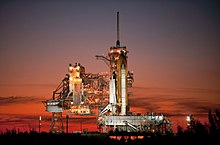
The Space Shuttle Atlantis (STS-129) is seen on launch pad 39A at the NASA Kennedy Infinite Center shortly afterward the rotating service construction was rolled back on Nov 15, 2009.
As the Infinite Shuttle was being designed, NASA received proposals for building alternative launch-and-landing sites at locations other than KSC, which demanded report. KSC had important advantages, including its existing facilities; location on the Intracoastal Waterway; and its southern breadth, which gives a velocity advantage to missions launched in easterly near-equatorial orbits. Disadvantages included: its inability to safely launch military missions into polar orbit, since spent boosters would be likely to fall on the Carolinas or Republic of cuba; corrosion from the salt air; and frequent cloudy or stormy weather. Although building a new site at White Sands Missile Range in New Mexico was seriously considered, NASA announced its decision in April 1972 to use KSC for the shuttle.[22] Since the Shuttle could not exist landed automatically or by remote control, the launch of Columbia on April 12, 1981 for its kickoff orbital mission STS-1, was NASA's showtime crewed launch of a vehicle that had non been tested in prior uncrewed launches.
In 1976, the VAB's south parking area was the site of Tertiary Century America, a scientific discipline and technology brandish commemorating the U.S. Bicentennial. Concurrent with this event, the U.S. flag was painted on the s side of the VAB. During the late 1970s, LC-39 was reconfigured to back up the Infinite Shuttle. Ii Orbiter Processing Facilities were built near the VAB every bit hangars with a 3rd added in the 1980s.
KSC's 2.9-mile (iv.7 km) Shuttle Landing Facility (SLF) was the orbiters' principal stop-of-mission landing site, although the get-go KSC landing did non accept place until the 10th flight, when Challenger completed STS-41-B on February 11, 1984; the main landing site until then was Edwards Air Force Base of operations in California, subsequently used every bit a backup landing site. The SLF as well provided a return-to-launch-site (RTLS) arrest option, which was not utilized. The SLF is among the longest runways in the world.[23]
After 24 successful shuttle flights, Challenger was torn apart 73 seconds later the launch of STS-51-L on January 28, 1986; the first shuttle launch from Pad 39B and the showtime U.S. crewed launch failure, killing the seven coiffure members. An O-ring seal in the right booster rocket failed at liftoff, leading to subsequent structural failures. Flights resumed on September 29, 1988, with STS-26 after modifications to many aspects of the shuttle program.
On February one, 2003, Columbia and her crew of seven were lost during re-entry over Texas during the STS-107 mission (the 113th shuttle flying); a vehicle breakup triggered by harm sustained during launch from Pad 39A on January 16, when a piece of foam insulation from the orbiter's external fuel tank struck the orbiter's left-wing. During reentry, the impairment created a hole allowing hot gases to melt the fly structure. Like the Challenger disaster, the resulting investigation and modifications interrupted shuttle flying operations at KSC for more than 2 years until the STS-114 launch on July 26, 2005.
The shuttle programme experienced five main engine shutdowns at LC-39, all within 4 seconds before launch; and one Arrest to Orbit, STS-51-F on July 29, 1985. Shuttle missions during nearly 30 years of operations included deploying satellites and interplanetary probes, conducting space scientific discipline and technology experiments, visits to the Russian MIR space station, construction and servicing of the International Space Station, deployment and servicing of the Hubble Infinite Telescope and serving as a space laboratory. The shuttle was retired from service in July 2011 after 135 launches.
Constellation [edit]
On October 28, 2009, the Ares I-X launch from Pad 39B was the commencement uncrewed launch from KSC since the Skylab workshop in 1973.
Expendable launch vehicles (ELVs) [edit]
Beginning in 1958, NASA and military worked side by side on robotic mission launches (previously referred to as unmanned),[24] cooperating as they broke basis in the field. In the early on 1960s, NASA had as many as two robotic mission launches a calendar month. The frequent number of flights allowed for quick development of the vehicles, as engineers gathered information, learned from anomalies and implemented upgrades. In 1963, with the intent of KSC ELV work focusing on the ground support equipment and facilities, a divide Atlas/Centaur system was formed under NASA's Lewis Middle (now Glenn Research Center (GRC)), taking that responsibility from the Launch Operations Center (aka KSC).[eight]
Though near all robotics missions launched from the Cape Canaveral Space Force Station (CCSFS), KSC "oversaw the final assembly and testing of rockets as they arrived at the Greatcoat."[eight] In 1965, KSC's Unmanned Launch Operations directorate became responsible for all NASA uncrewed launch operations, including those at Vandenberg Infinite Strength Base. From the 1950s to 1978, KSC chose the rocket and payload processing facilities for all robotic missions launching in the U.Due south., overseeing their near launch processing and checkout. In improver to government missions, KSC performed this service for commercial and strange missions also, though non-U.S. government entities provided reimbursement. NASA as well funded Cape Canaveral Space Force Station launch pad maintenance and launch vehicle improvements.
All this changed with the Commercial Space Launch Human activity of 1984, afterwards which NASA just coordinated its own and National Oceanic and Atmospheric Administration (NOAA) ELV launches. Companies were able to "operate their own launch vehicles"[eight] and utilize NASA's launch facilities. Payload processing handled past private firms also started to occur outside of KSC. Reagan's 1988 space policy furthered the movement of this piece of work from KSC to commercial companies.[25] That aforementioned twelvemonth, launch complexes on Cape Canaveral Air Forcefulness Strength Station started transferring from NASA to Air Force Space Command management.[8]
In the 1990s, though KSC was not performing the easily-on ELV work, engineers still maintained an understanding of ELVs and had contracts assuasive them insight into the vehicles so they could provide knowledgeable oversight. KSC also worked on ELV research and analysis and the contractors were able to utilize KSC personnel as a resource for technical issues. KSC, with the payload and launch vehicle industries, adult advances in automation of the ELV launch and ground operations to enable competitiveness of U.S. rockets against the global market.[viii]
In 1998, the Launch Services Plan (LSP) formed at KSC, pulling together programs (and personnel) that already existed at KSC, GRC, Goddard Space Flight Middle, and more to manage the launch of NASA and NOAA robotic missions. Cape Canaveral Space Force Station and VAFB are the primary launch sites for LSP missions, though other sites are occasionally used. LSP payloads such equally the Mars Scientific discipline Laboratory accept been processed at KSC before being transferred to a launch pad on Greatcoat Canaveral Space Force Station.
Space station processing [edit]
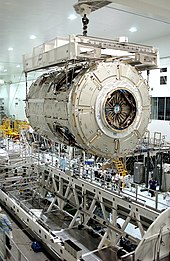
As the International Space Station modules pattern began in the early on 1990s, KSC began to work with other NASA centers and international partners to set for processing before launch onboard the Space Shuttles. KSC utilized its hands-on experience processing the 22 Spacelab missions in the Operations and Checkout Edifice to assemble expectations of ISS processing. These experiences were incorporated into the design of the Infinite Station Processing Facility (SSPF), which began structure in 1991. The Space Station Directorate formed in 1996. KSC personnel were embedded at station module factories for insight into their processes.[8]
From 1997 to 2007, KSC planned and performed on the ground integration tests and checkouts of station modules: three Multi-Element Integration Testing (MEIT) sessions and the Integration Systems Test (IST). Numerous issues were found and corrected that would take been difficult to nearly incommunicable to do on-orbit.
Today KSC continues to process ISS payloads from across the world before launch forth with developing its experiments for on orbit.[26] The proposed Lunar Gateway would be manufactured and candy at the Infinite Station Processing Facility.
Electric current programs and initiatives [edit]
The following are current programs and initiatives at Kennedy Space Middle:[27]
- Commercial Coiffure Program[28]
- Exploration Ground Systems Program[29]
- NASA is currently designing the adjacent heavy launch vehicle known as the Space Launch System (SLS) for continuation of human spaceflight.
- On December 5, 2014, NASA launched the first uncrewed flight test of the Orion Multi-Purpose Crew Vehicle (MPCV), currently under development to facilitate human exploration of the Moon and Mars.[30] [31]
- Launch Services Program[32]
- Educational Launch of Nanosatellites (ELaNa)[33]
- Research and Technology[9]
- Artemis programme
- Lunar Gateway
- International Infinite Station Payloads[26]
- Camp KSC: educational camps for schoolchildren in jump and summer, with a focus on space, aviation and robotics.[34]
Facilities [edit]
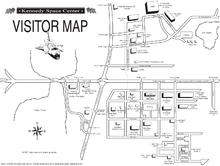
The KSC Industrial Surface area, where many of the center's back up facilities are located, is 5 miles (8 km) southward of LC-39. It includes the Headquarters Building, the Operations and Checkout Edifice and the Central Instrumentation Facility. The astronaut crew quarters are in the O&C; before information technology was completed, the astronaut crew quarters were located in Hangar S[35] at the Cape Canaveral Missile Test Annex (now Cape Canaveral Space Force Station).[16] Located at KSC was the Merritt Island Spaceflight Tracking and Information Network station (MILA), a cardinal radio communications and spacecraft tracking complex.
Facilities at the Kennedy Infinite Center are directly related to its mission to launch and recover missions. Facilities are bachelor to gear up and maintain spacecraft and payloads for flight.[36] [37] The Headquarters (HQ) Building houses offices for the Center Director, library, pic and photo archives, a print shop and security.[38] When the KSC Library first opened, information technology was part of the Army Ballistic Missile Bureau. However, in 1965, the library moved into three separate sections in the newly opened NASA headquarters before eventually becoming a single unit in 1970.[39] The library contains over four million items related to the history and the work at Kennedy. As one of ten NASA centre libraries in the country, their drove focuses on engineering, scientific discipline, and technology. The athenaeum contain planning documents, motion picture reels, and original photographs covering the history of KSC. The library is not open up to the public but is available for KSC, Space Force, and Navy employees who work on site.[39] Many of the media items from the drove are digitized and bachelor through NASA's KSC Media Gallery or through their more upwards-to-date Flickr gallery.
A new Headquarters Edifice was completed in 2019 as part of the Fundamental Campus consolidation. Groundbreaking began in 2014.[eleven] [40] [41] [42]
The centre operated its ain 17-mile (27 km) short-line railroad.[43] This operation was discontinued in 2015, with the sale of its final two locomotives. A 3rd had already been donated to a museum. The line was costing $i.iii million annually to maintain.[44]
Payload manufacture and processing [edit]
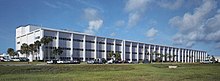
Neil Armstrong Operations and Checkout Building
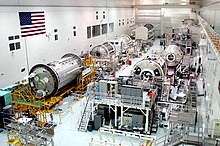
Pre-made ISS modules in the Infinite Station Processing Facility

Bluish Origin's manufacturing facility nearly KSC visitor circuitous
- The Neil Armstrong Operations and Checkout Edifice (O&C) (previously known equally the Manned Spacecraft Operations Building) is a historic site on the U.Southward. National Annals of Historic Places dating back to the 1960s and was used to receive, process, and integrate payloads for the Gemini and Apollo programs, the Skylab plan in the 1970s, and for initial segments of the International Space Station through the 1990s.[45] The Apollo and Space Shuttle astronauts would board the astronaut transfer van to launch complex 39 from the O&C edifice.[46]
- The three-story, 457,000-square-foot (42,500 thousand2) Space Station Processing Facility (SSPF) consists of ii enormous processing bays, an airlock, operational control rooms, laboratories, logistics areas and role infinite for support of non-hazardous Space Station and Shuttle payloads to ISO 14644-1 class v standards.[47] Opened in 1994, it is the largest factory building in the KSC industrial area.
- The Vertical Processing Facility (VPF) features a 71-by-38-foot (22 by 12 1000) door where payloads that are candy in the vertical position are brought in and manipulated with 2 overhead cranes and a hoist capable of lifting up to 35 brusque tons (32 t).[48]
- The Hypergolic Maintenance and Checkout Area (HMCA) comprises three buildings that are isolated from the residual of the industrial area because of the hazardous materials handled there. Hypergolic-fueled modules that made up the Space Shuttle Orbiter's reaction control organisation, orbital maneuvering system and auxiliary power units were stored and serviced in the HMCF.[49]
- The Multi-Payload Processing Facility is a 19,647 foursquare feet (1,825.three m2)[50] building used for Orion spacecraft and payload processing.
- The Payload Hazardous Servicing Facility (PHSF) contains a 70-by-110-foot (21 by 34 m) service bay, with a 100,000-pound (45,000 kg), 85-foot (26 m) hook acme. It also contains a 58-by-80-foot (18 by 24 m) payload airlock. Its temperature is maintained at 70 °F (21 °C).[51]
- The Blue Origin rocket manufacturing facility is located immediately southward of the KSC visitor circuitous. Completed in 2019, information technology serves as the company'southward factory for the manufacture of New Glenn orbital rockets.[52]
Launch Circuitous 39 [edit]
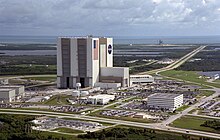
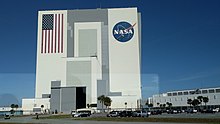
Launch Circuitous 39 (LC-39) was originally congenital for the Saturn V, the largest and about powerful operational launch vehicle in history, for the Apollo crewed Moon landing plan. Since the end of the Apollo program in 1972, LC-39 has been used to launch every NASA human space flying, including Skylab (1973), the Apollo-Soyuz Test Project (1975), and the Infinite Shuttle programme (1981–2011).
Since December 1968, all launch operations have been conducted from launch pads A and B at LC-39. Both pads are on the ocean, 3 miles (4.8 km) eastward of the VAB. From 1969 to 1972, LC-39 was the "Moonport" for all six Apollo crewed Moon landing missions using the Saturn 5,[53] and was used from 1981 to 2011 for all Space Shuttle launches.
Human missions to the Moon required the big 3-stage Saturn V rocket, which was 363 feet (111 meters) tall and 33 anxiety (10 meters) in bore. At KSC, Launch Complex 39 was built on Merritt Island to accommodate the new rocket. Construction of the $800 million projection began in November 1962. LC-39 pads A and B were completed by October 1965 (planned Pads C, D and E were canceled), the VAB was completed in June 1965, and the infrastructure by late 1966.
The complex includes:
- the Vehicle Assembly Building (VAB), a 130,000,000 cubic feet (3,700,000 miii) hangar capable of holding iv Saturn Vs. The VAB was the largest construction in the world by volume when completed in 1965.[54]
- a transporter capable of carrying v,440 tons along a crawlerway to either of two launch pads;
- a 446-foot (136 grand) mobile service structure, with three Mobile Launcher Platforms, each containing a fixed launch umbilical belfry;
- the Launch Control Center; and
- a news media facility.
Launch Circuitous 48 [edit]
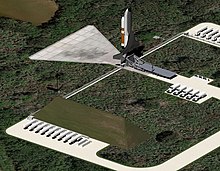
Launch Complex 48 (LC-48) is a multi-user launch site under construction for minor launchers and spacecraft. It will exist located betwixt Launch Circuitous 39A and Infinite Launch Complex 41, with LC-39A to the north and SLC-41 to the south.[55] LC-48 volition be synthetic as a "clean pad" to support multiple launch systems with differing propellant needs. While initially merely planned to have a single pad, the complex is capable of beingness expanded to two at a later date.[56]
Commercial leasing [edit]
As a part of promoting commercial space manufacture growth in the area and the overall center as a multi-user spaceport,[57] [58] KSC leases some of its backdrop. Here are some major examples:
- Exploration Park to multiple users (partnership with Space Florida)
- Shuttle Landing Facility to Infinite Florida (who contracts use to private companies)
- Orbiter Processing Facility (OPF)-3 to Boeing (for CST-100 Starliner)
- Launch Circuitous 39A to SpaceX
- O&C High Bay to Lockheed Martin (for Orion processing)
- State for FPL'south Space Declension Next Generation Solar Free energy Eye to Florida Power and Low-cal (FPL)[59] [60] [61]
- Hypergolic Maintenance Facility (HMF) to United Paradyne Corporation (UPC)[62]
Visitor complex [edit]
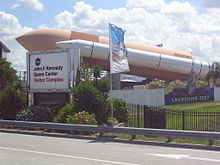
The Kennedy Space Middle Company Complex, operated past Delaware North since 1995, has a diverseness of exhibits, artifacts, displays and attractions on the history and time to come of homo and robotic spaceflight. Omnibus tours of KSC originate from here. The circuitous as well includes the split up Apollo/Saturn V Middle, n of the VAB and the U.s. Astronaut Hall of Fame, half-dozen miles west virtually Titusville. There were 1.5 one thousand thousand visitors in 2009. Information technology had some 700 employees.[63]
It was announced on May 29, 2015, that the Astronaut Hall of Fame exhibit would be moved from its electric current location to another location inside the Visitor Complex to make room for an upcoming high-tech attraction entitled "Heroes and Legends". The attraction, designed by Orlando-based design business firm Falcon'southward Treehouse, opened November 11, 2016.[64]
In March 2016, the visitor centre unveiled the new location of the iconic countdown clock at the complex'southward entrance; previously, the clock was located with a flagpole at the press site. The clock was originally built and installed in 1969 and listed with the flagpole in the National Register of Historic Places in January 2000.[65] In 2019, NASA celebrated the 50th ceremony of the Apollo program, and the launch of Apollo 10 on May 18.[66] In summer of 2019, Lunar Module 9 (LM-nine) was relocated to the Apollo/Saturn Five Center as office of an initiative to rededicate the center and celebrate the 50th anniversary of the Apollo Program.
Historic locations [edit]
NASA lists the following Celebrated Districts at KSC; each commune has multiple associated facilities:[67] [68] [69]
- Launch Circuitous 39: Pad A Historic District
- Launch Complex 39: Pad B Historic District
- Shuttle Landing Facility (SLF) Area Historic Commune
- Orbiter Processing Celebrated District
- Solid Rocket Booster (SRB) Disassembly and Refurbishment Complex Celebrated District
- NASA KSC Railroad System Celebrated District
- NASA-owned Cape Canaveral Space Strength Station Industrial Surface area Historic District
At that place are 24 historic properties outside of these historic districts, including the Space Shuttle Atlantis, Vehicle Assembly Edifice, Crawlerway, and Operations and Checkout Building.[67] KSC has ane National Historic Landmark, 78 National Register of Celebrated Places (NRHP) listed or eligible sites, and 100 Archaeological Sites.[seventy]
Other facilities [edit]
- The Rotation, Processing and Surge Facility (RPSF) is responsible for the preparation of solid rocket booster segments for transportation to the Vehicle Assembly Building (VAB). The RPSF was built in 1984 to perform SRB operations that had previously been conducted in high trophy ii and iv of the VAB at the first of the Infinite Shuttle program. It was used until the Space Shuttle'south retirement, and will be used in the hereafter by the Infinite Launch System[71] (SLS) and OmegA rockets.
Weather [edit]
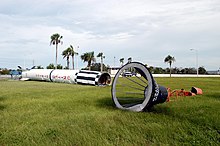
A Mercury Redstone rocket on brandish at Gate 3 was toppled past Hurricane Frances on September 7, 2004.
Florida's peninsular shape and temperature contrasts betwixt state and sea provide platonic weather condition for electric storms, earning Primal Florida the reputation equally "lightning majuscule of the The states".[72] [73] This makes extensive lightning protection and detection systems necessary to protect employees, structures and spacecraft on launch pads.[74] On November 14, 1969, Apollo 12 was struck by lightning simply after lift-off from Pad 39A, merely the flying continued safely. The most powerful lightning strike recorded at KSC occurred at LC-39B on August 25, 2006, while shuttle Atlantis was being prepared for STS-115. NASA managers were initially concerned that the lightning strike acquired damage to Atlantis, but none was found.[75]
On September 7, 2004, Hurricane Frances directly striking the area with sustained winds of seventy miles per hour (110 km/h) and gusts upwards to 94 miles per 60 minutes (151 km/h), the about damaging tempest to appointment. The Vehicle Assembly Building lost 1,000 exterior panels, each 3.9 anxiety (i.ii k) 10 nine.8 feet (3.0 thou) in size. This exposed 39,800 sq ft (three,700 thou2) of the building to the elements. Damage occurred to the s and east sides of the VAB. The shuttle'southward Thermal Protection Organisation Facility suffered all-encompassing damage. The roof was partially torn off and the interior suffered water damage. Several rockets on display in the center were toppled.[76] Farther impairment to KSC was acquired by Hurricane Wilma in October 2005.
The bourgeois gauge by NASA is that the Space Center will experience 5 to 8 inches of sea level rise by the 2050s. Launch Complex 39A, the site of the Apollo eleven launch, is the most vulnerable to flooding, and has a 14% annual take a chance of flooding outset in 2020.[77] [78]
KSC directors [edit]
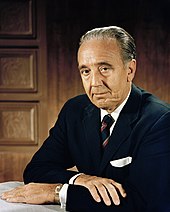
Dr. Kurt Debus, first manager of KSC
Since KSC'south formation, ten NASA officials take served as directors, including three former astronauts (Crippen, Bridges and Cabana):
| Name | Start | Finish | Reference |
|---|---|---|---|
| Dr. Kurt H. Debus | July 1962 | November 1974 | [79] |
| Lee R. Scherer | Jan xix, 1975 | September 2, 1979 | [lxxx] |
| Richard Thousand. Smith | September 26, 1979 | August 2, 1986 | [81] |
| Forrest South. McCartney | Baronial 31, 1987 | December 31, 1991 | [82] |
| Robert Fifty. Crippen | January 1992 | Jan 1995 | [83] |
| Jay F. Honeycutt | Jan 1995 | March 2, 1997 | [84] |
| Roy D. Bridges, Jr. | March 2, 1997 | August 9, 2003 | [85] |
| James Due west. Kennedy | August 9, 2003 | Jan 2007 | [86] |
| William W. Parsons | January 2007 | October 2008 | [87] |
| Robert D. Cabana | October 2008 | May 2021 | [88] |
| Janet E. Petro | June 2021 | Present | [89] |
Labor strength [edit]
When KSC separated from Marshall Space Flight Center in July 1962, it took 375 employees with information technology.
In May 1965, KSC had 7,000 employees and contractors motion from rented space in Cocoa Beach to the new Merritt Island facilities. The peak number of persons working at the center was 26,000 in 1968 (iii,000 were civil servants). In 1970, President Nixon appear intent to reduce the cost of space operations and major cuts occurred at KSC. By 1974, KSC's workforce was down to 10,000 employees (2,408 civil servants).[eight]
A full of 13,100 people worked at the center as of 2011. Approximately 2,100 are employees of the federal government; the rest are contractors.[ninety] The boilerplate annual salary for an on-site worker in 2008 was $77,235.[91]
The end of the Space Shuttle program in 2011, preceded by the cancellation of Constellation Program in 2010, produced a significant downsizing of the KSC workforce similar to that experienced at the end of the Apollo program in 1972. Equally part of this downsizing, half-dozen,000 contractors lost their jobs at the center during 2010 and 2011.[92]
In popular culture [edit]
In improver to being oftentimes featured in documentaries, Kennedy Infinite Center has been portrayed on film many times. Some studio movies have even gained access and filmed scenes inside the gates of the space eye. If extras are needed in those scenes, space center employees are recruited (employees use personal fourth dimension during filming). Films with scenes at KSC include:[93]
- Moonraker
- SpaceCamp
- Apollo xiii
- Contact
- Armageddon [94]
- Space Cowboys
- Swades
- Transformers 3: Nighttime of the Moon
- Tomorrowland
- Sharknado 3: Oh Hell No!
- First Man
- Geostorm
- Men in Blackness three
Several tv shows have had KSC as one of the primary settings, though not necessarily with any scenes filmed on eye:
- I Dream of Jeannie
- The Cape
- The Astronaut Wives Club
British-Irish band I Direction besides filmed their music video for "Drag Me Down" at KSC.
Kennedy Infinite Centre serves every bit the location of the final boxing virtually the finish of Stone Bounding main between the Joestar Group and Enrico Pucci.[95]
Encounter also [edit]
- Air Strength Space and Missile Museum
- Astronaut beach firm
- Launch Complex 34 – used for the smaller Apollo Saturn I and Saturn IB rockets
- Launch Complex 37 – used for the smaller Apollo Saturn I and Saturn IB rockets
- List of memorials to John F. Kennedy
- Listing of tallest buildings and structures in the world
- Mobile launcher platform
- NASA Causeway
- Solar eclipse of August 12, 2045 (Kennedy Space Middle will be in the path of totality)
- Swamp Works
- Crawler-transporter
Notes [edit]
- ^ Number includes commercial tenants.
References [edit]
Citations [edit]
- ^ Kennedy Space Eye gets first adult female director, Janet Petro, later Bob Cabana promoted to NASA.
- ^ a b 2021 Kennedy Space Center Annual Study (PDF). NASA. 2021. pp. 50, 48. Retrieved Feb 3, 2022.
- ^ "Kennedy Business Report" (PDF). Annual Report FY2010. NASA. Feb 2011. Retrieved August 22, 2011.
- ^ "Kennedy Space Center Implementing NASA's Strategies" (PDF). NASA. 2000. Retrieved November 5, 2015.
- ^ "Appendix ten – Regime Organizations Supporting Project Mercury". NASA History Plan Office. NASA. Retrieved November 6, 2015.
- ^ "ii. Project Support from the NASA Centers". Mercury Project Summary (NASA SP-45). NASA. Retrieved Nov six, 2015.
- ^ "Mercury Mission Control". NASA. Retrieved November 6, 2015.
- ^ a b c d due east f g h Lipartito, Kenneth; Butler, Orville (2007). 'A History of the Kennedy Space Center. University Press of Florida. ISBN978-0-8130-3069-2.
- ^ a b "Enquiry & Technology". Kennedy Infinite Center. NASA. March 3, 2015. Retrieved November 5, 2015.
- ^ "NASA Partnerships Launch Multi-User Spaceport". NASA. May 1, 2014. Retrieved November 5, 2015.
- ^ a b "Kennedy Creating New Master Plan". NASA. March 12, 2012. Retrieved November 5, 2015.
- ^ "Kennedy Space Center Story". NASA. Retrieved May 13, 2019.
- ^ "History of Cape Canaveral Chapter three | Spaceline". Retrieved May 27, 2021.
- ^ Charles D. Benson; William Barnaby Faherty. "State, Lots of Land – Much of It Marshy". Moonport: A History of Apollo Launch Facilities and Operations. NASA. Retrieved August 27, 2009.
- ^ Muschamp, Herbert (Jan 28, 1999). "Charles Luckman, Architect Who Designed Penn Station's Replacement, Dies at 89". The New York Times . Retrieved August 22, 2011.
- ^ a b "Kennedy History Quiz". NASA. Retrieved November 5, 2015.
- ^ "The National Athenaeum, Lyndon B. Johnson Executive Order 11129". Retrieved April 26, 2010.
- ^ "Kennedy Infinite Center Story". NASA. 1991. Retrieved November 5, 2015.
- ^ Benson, Charles D.; Faherty, William B. (August 1977). "Chapter 7: The Launch Directorate Becomes an Operational Center – Kennedy'due south Last Visit". Moonport: A History of Apollo Launch Facilities and Operations. History Series. Vol. SP-4204. NASA. Archived from the original on November six, 2004.
- ^ "Come across All Attractions | Kennedy Infinite Center". www.kennedyspacecenter.com . Retrieved June 5, 2020.
- ^ "Apollo 11 Mission Overview". April 17, 2015.
- ^ Heppenheimer, T. A. (1998). The Space Shuttle Decision. NASA. pp. 425–427. Archived from the original on Oct 30, 2004.
- ^ Shuttle Landing Facility (SLF). Science.ksc.nasa.gov. Retrieved on May 5, 2012.
- ^ "Mode Guide for NASA History Authors and Editors". NASA's History Role. NASA. Retrieved November 6, 2015.
- ^ "Presidential Directive on National Space Policy". NASA. White Business firm. February 11, 1988. Retrieved November 6, 2015.
- ^ a b "Kennedy Space Center Payload Processing". NASA. March two, 2015. Retrieved Nov 5, 2015.
- ^ "Kennedy Space Center". NASA. March 27, 2015. Retrieved November 5, 2015.
- ^ "Commercial Coiffure Program". NASA. March 31, 2015. Retrieved November 5, 2015.
- ^ "Exploration Ground Systems". NASA. March 3, 2015. Retrieved Oct 13, 2018.
- ^ Garcia, Marker (Apr 12, 2015). "Orion Overview". NASA . Retrieved January 17, 2017.
- ^ "Orion Explained: NASA's Multi-Purpose Crew Vehicle (Infographic)". Space.com . Retrieved January 17, 2017.
- ^ "Launching Rockets". NASA. April 2015. Retrieved November 5, 2015.
- ^ "Minor Satellite Missions". NASA. April 13, 2015. Retrieved November 5, 2015.
- ^ "Military camp Kennedy Space Center and Infinite Camp". NASA. Apr 28, 2015. Retrieved September 18, 2019.
- ^ "Hangar S History". Kennedy Infinite Heart. NASA. May 18, 2015. Retrieved November 5, 2015.
- ^ "iv. Kennedy Space Center Planning and Development Function – What Nosotros Offer – Physical Assets". Archived from the original on Apr 4, 2014. Retrieved March 4, 2014.
- ^ "Kennedy Infinite Center Resources Encyclopedia". NASA – Kennedy Space Center. 2010. Retrieved March 4, 2014.
- ^ Headquarters Building (HQ). Science.ksc.nasa.gov. Retrieved on May 5, 2012.
- ^ a b Borchert, Carol Ann; Arthur, Michael A. (2007). Ginanni, Katy (ed.). "John F. Kennedy Infinite Heart Library". Serials Review. 33 (4): 277–280. doi:10.1016/j.serrev.2007.08.012 – via Academia.edu.
- ^ "Kennedy Infinite Center Fundamental Campus". NASA. March 25, 2015. Retrieved February 3, 2016.
- ^ "Fundamental Campus of the Kennedy Space Center" (PDF). Kennedy Space Middle Fact Sheets. NASA. Retrieved February iii, 2016.
- ^ "Media Invited to Groundbreaking for New Kennedy Infinite Center Headquarters". NASA. October ii, 2014. Retrieved Nov 5, 2015.
- ^ "The NASA Railroad" (PDF). Kennedy Space Eye Fact Sheets. NASA. Retrieved Feb 3, 2016.
- ^ Dean, James (May 24, 2015). "NASA Railroad rides into sunset". Florida Today. Melbourne, Florida. p. 25A. Retrieved June 2, 2015.
- ^ "Operations and Checkout Building".
- ^ Mansfield, Cheryl L. (July 15, 2008). "Catching a Ride to Destiny". NASA. Retrieved July 13, 2009.
- ^ Space Station Processing Facility (SSPF). Science.ksc.nasa.gov. Retrieved on May v, 2012.
- ^ Vertical Processing Facility. Science.ksc.nasa.gov. Retrieved on May five, 2012.
- ^ "Hypergolic Maintenance and Checkout Facility".
- ^ Granath, Bob (August 25, 2016). "Multi-Payload Processing Facility Provides 'Gas Station' for Orion". NASA . Retrieved December i, 2019.
- ^ "Payload Hazardous Servicing Facility". Science.ksc.nasa.gov. Retrieved May 2, 2018.
- ^ Bergin, Chris; Munson, Noel (March 29, 2017). "Blue Origin working towards making the Cape its Orbital Launch Site". NASASpaceFlight . Retrieved January twenty, 2018.
- ^ Benson, Charles D.; Faherty, William B. (Baronial 1977). "Preface". Moonport: A History of Apollo Launch Facilities and Operations. History Serial. Vol. SP-4204. NASA.
- ^ "Senate". Congressional Tape: 17598. September 8, 2004.
- ^ Kelly, Emre (June 14, 2019). "Meet Launch Circuitous 48, NASA's new small rocket pad at Kennedy Space Center". Florida Today . Retrieved January vii, 2020.
- ^ Draft Environmental Assessment for Launch Complex 48 (PDF). NASA. Feb 19, 2019. pp. two–iii. Retrieved January seven, 2020.
- ^ "Partnering with KSC". Archived from the original on November iv, 2015.
- ^ "The Front end Page Archive". Doing Business With Kennedy. NASA. March 26, 2015. Retrieved Nov 5, 2015.
- ^ "Partnering with KSC".
- ^ "Solar Free energy Centers". FPL.
- ^ "Infinite Coast Next Generation Solar Energy Center". Sustainability. NASA. June 7, 2013. Retrieved November 5, 2015.
- ^ "Partnering with KSC".
- ^ Stratford, Amanda (January 12, 2010). "NASA'southward new image". Florida Today. Melbourne, Florida: Florida Today. pp. 1A.
- ^ Dean, James. "KSC Visitor Complex introduces 'Heroes and Legends'". Florida Today . Retrieved August half dozen, 2015.
- ^ "Iconic KSC countdown clock gets a new home". News thirteen. March 1, 2016. Retrieved March 2, 2016.
- ^ "Honoring Apollo 10 | Apollo Program 50th Anniversary Celebrations". Archived from the original on April 8, 2019.
- ^ a b "Historic Properties at Kennedy Space Eye Equally of January 2015" (PDF). Environmental Planning – Cultural Resource. NASA. Archived from the original (PDF) on March three, 2016. Retrieved November 5, 2015.
- ^ "Understanding NASA's Historic Districts" (PDF). Environmental Program at KSC. NASA. June 2008. Archived from the original (PDF) on Nov 17, 2015. Retrieved November v, 2015.
- ^ "Environmental Planning – Cultural Resources". Environmental Programme at KSC. NASA. Archived from the original on September 22, 2015. Retrieved November 5, 2015.
- ^ "NASA'due south Historic Preservation Plan: Jubilant and Managing Significant Historic Resource" (PDF). NASA. Archived from the original (PDF) on November 17, 2015. Retrieved November 5, 2015.
- ^ "NASAfacts: Rotation, Processing and Surge Facility (RPSF) at Kennedy Space Centre" (PDF). NASA. Retrieved December 21, 2019.
- ^ Oliver, John Due east. (2005). Encyclopedia of world climatology. Springer. p. 452. ISBN978-1-4020-3264-6.
- ^ "Lightning: FAQ". UCAR Communications. University Corporation for Atmospheric Research. Archived from the original on March xvi, 2010. Retrieved June 17, 2010.
- ^ KSC – Lightning and the Infinite Program Archived September 24, 2008, at the Wayback Machine Retrieved May 28, 2008
- ^ "NASA Checks Shuttle After Lightning Strike Virtually Launch Pad". Space.com . Retrieved October 19, 2017.
- ^ "NASA Assesses Hurricane Frances Damage". NASA Press Release.
- ^ Horn-Muller, Ayurella; Joy, Rachael (November 14, 2019). "Could Kennedy Space Eye launch pads be at risk equally climate changes? Experts say yeah". Climate Central / Florida Today . Retrieved December 11, 2019.
- ^ "Future Alluvion Run a risk: John F. Kennedy Infinite Middle & Greatcoat Canaveral Air Forcefulness Station" (PDF). Climate Central. October 2019. Retrieved Dec 11, 2019.
- ^ NASA – Biography of Dr. Kurt H. Debus. Nasa.gov. Retrieved on May v, 2012.
- ^ NASA – Biography of Lee R. Scherer. Nasa.gov. Retrieved on May v, 2012.
- ^ NASA – Biography of Richard G. Smith. Nasa.gov. Retrieved on May v, 2012.
- ^ NASA – Biography of Forrest S. McCartney. Nasa.gov. Retrieved on May 5, 2012.
- ^ NASA – Biography of Robert 50. Crippen. Nasa.gov. Retrieved on May v, 2012.
- ^ NASA – Biography of Jay F. Honeycutt. Nasa.gov. Retrieved on May 5, 2012.
- ^ NASA – Biography of Roy Bridges. Nasa.gov. Retrieved on May 5, 2012.
- ^ NASA – NASA KSC Manager Announces Retirement. Nasa.gov (February 24, 2008). Retrieved on May 5, 2012.
- ^ NASA – Biography of William W. (Pecker) Parsons. Nasa.gov (February 24, 2008). Retrieved on May v, 2012.
- ^ "Cabana to Succeed Parsons as Kennedy Space Center Director" (Press release). NASA. September 30, 2008. Retrieved September xxx, 2008.
- ^ Kennedy Space Heart gets first adult female director, Janet Petro, afterwards Bob Cabana promoted to NASA, Orlando Lookout man, June xxx, 2021, retrieved July 1, 2021
- ^ Dean, James (March 17, 2011). "NASA budget woes leads to layoffs". Federal Times . Retrieved August 21, 2011.
- ^ Peterson, Patrick (November 28, 2010). "High-paying jobs scant outside KSC". Melbourne, Florida: Florida Today. pp. 1A.
- ^ Dean, James (November 5, 2011). "Laid-off KSC workers' supplies eagerly accustomed by educators". Florida Today. Melbourne, Florida. pp. 2B.
- ^ Sangalang, Jennifer (January xix, 2018). "Hey, girl: Casting call for Ryan Gosling picture show 'First Man' at Kennedy Space Center". Florida Today. Usa Today Network. Retrieved January 30, 2018.
- ^ "Armageddon Product Notes". Michael Bay. October 4, 2012. Retrieved January 30, 2018.
- ^ Araki, Hirohiko (April 4, 2003). JoJo'south Bizarre Hazard: Stone Ocean. Shueisha. ISBN978-4-08-873410-one.
Sources [edit]
- Benson, Charles W.; Faherty, William Barnaby (1978). Moonport: A History of Apollo Launch Facilities and Operations. Scientific and Technical Information Part, NASA. Archived from the original on November 17, 2004. .
- Middleton, Sallie. "Space Rush: Local Impact of Federal Aerospace Programs on Brevard and Surrounding Counties," Florida Historical Quarterly, Fall 2008, Vol. 87 Issue 2, pp. 258–289.
- Reynolds, David West (September 2006). Kennedy Space Center: Gateway to Infinite. Buffalo, NY: Firefly Books. ISBN978-i-55407-039-8 . Retrieved Jan 30, 2010.
-
 This article incorporates public domain textile from websites or documents of the National Aeronautics and Infinite Administration.
External links [edit]
- Kennedy Space Centre Spider web site
- Kennedy History Vault
- Spaceport News KSC Employee Magazine
- KSC Visitor Complex Spider web site
- Streaming sound of KSC radio communications
- Astronauts Memorial Foundation Spider web site
- "America's Infinite Program: Exploring a New Frontier", a National Park Service Instruction with Celebrated Places lesson plan
- "Aviation: From Sand Dunes to Sonic Booms", a National Park Service Discover Our Shared Heritage travel itinerary
- A Field Guide to American Spacecraft
- Documentary of the U.South. Space Programme in Florida
flanaganlapet1987.blogspot.com
Source: https://en.wikipedia.org/wiki/Kennedy_Space_Center
 Kennedy Space Center Fl Reviews)
แสดงความคิดเห็น for "Kennedy Athletic Recreation and Social (Military) Kennedy Space Center Fl Reviews"